
When several people live under one roof, hot water can disappear surprisingly fast. One person is taking a shower, someone starts the washing machine, the dishwasher is running, and suddenly the next person is standing under lukewarm water wondering what happened.
For many family homeowners, choosing the right 50 gallon water heater is less about buying another appliance and more about keeping everyday life running smoothly. A dependable water heater can make busy school mornings easier, help you get through laundry day without planning around showers, and reduce the frustration of constantly wondering whether there will be enough hot water left.
A 50-gallon electric tank is commonly considered by households of around three to five people, but capacity alone does not tell the whole story. Your shower habits, number of bathrooms, appliance use, incoming water temperature, and recovery rate all matter.
In this guide, we will look at whether a 50-gallon tank makes sense for a busy family, what to consider before buying, and where a model such as the Rheem PROE50 M2 RH95 Professional Classic Medium may fit into the picture.
Why Families Run Out of Hot Water So Easily
Think about a normal weekday morning in a family home.
Two adults need to get ready for work. Two children need to prepare for school. Someone wants a shower, another person needs the bathroom, yesterday’s clothes need washing, and the dishwasher may still be finishing its cycle.
Each activity may use hot water from the same tank.
The problem usually becomes noticeable when several hot-water activities happen close together rather than when a single fixture is being used.
Common examples include:
- Two or three showers taken one after another
- A shower running while the washing machine fills
- Filling a bathtub after another family member has showered
- Running the dishwasher during the morning routine
- Teenagers taking longer showers
- Guests staying overnight
- Multiple bathrooms being used around the same time
This is why a water heater that seemed perfectly adequate for two adults can start feeling undersized once children grow older or more people move into the home.
Is a 50 Gallon Water Heater Enough for 3–5 People?
For many households, a 50-gallon water heater can be a practical size for a family of three to five, particularly when hot-water use is reasonably spread throughout the day.
However, there is an important point homeowners often miss:
Tank capacity is not the same as the amount of uninterrupted hot water your household can use.
The actual experience depends on several things, including:
- How many people live in your home
- How long they shower
- Whether showers happen back-to-back
- Your showerhead flow rate
- How often laundry is done
- Whether appliances use hot water
- The temperature of incoming cold water
- The thermostat setting
- How quickly the heating elements restore hot water
A family of five that takes quick showers at different times may do perfectly well with a 50-gallon tank.
A family of four taking long showers one after another while simultaneously using laundry equipment may place much greater demand on the same 50 gallons.
So instead of asking only, “How many people can a 50-gallon heater support?” it is better to ask:
“How much hot water does our family use during its busiest hour?”
That question gives you a much clearer picture.
What 50 Gallons Looks Like in Everyday Family Life
Fifty gallons sounds like a lot until several household activities begin drawing from the tank.
Imagine this situation.
Mom showers first. One teenager goes next. Meanwhile, someone starts a load of laundry. Another person still needs a shower before school.
The water heater is not simply holding 50 gallons and waiting until the entire amount disappears. As hot water leaves the tank, incoming cold water replaces it, and the electric heating elements begin reheating the water.
How comfortable the third or fourth shower feels therefore depends partly on how quickly the tank can recover.
This is why household behavior matters.
A 50-gallon tank may be a comfortable fit when:
- You have approximately three to five household members
- Showers are relatively moderate in length
- Not everyone showers at exactly the same time
- Laundry and dishwashing can be staggered
- Your existing plumbing and electrical setup is appropriate
- Your peak hot-water demand matches the heater’s capabilities
You may need to look more carefully at sizing when:
- Five or more people regularly take long showers
- You have large soaking tubs
- Several bathrooms are routinely used simultaneously
- Hot-water appliances run during peak shower periods
- Your household frequently hosts overnight guests
- Your current 50-gallon heater already struggles despite working correctly
A plumber can help calculate peak-hour demand if your usage falls into the second group.
Signs Your Current Water Heater May Be Too Small
Running out of hot water once does not automatically mean you need a bigger tank.
Maybe several people happened to take unusually long showers that day.
But repeated problems deserve attention.
Watch for these signs:
- The final person showering regularly gets cold water
- Hot water runs out during normal morning routines
- Family members have to schedule showers around one another
- You avoid running the dishwasher while someone showers
- Laundry has to wait until everyone has finished bathing
- Your family has grown since the heater was installed
- You have added another bathroom or high-demand fixture
Before replacing the heater, make sure the current unit is actually operating correctly. Sediment buildup, thermostat problems, heating-element failure, or other issues can also reduce available hot water.
A correctly functioning water heater that is simply undersized requires a different solution from a damaged heater that is no longer producing its designed output.
40 Gallon vs. 50 Gallon Water Heater for Families
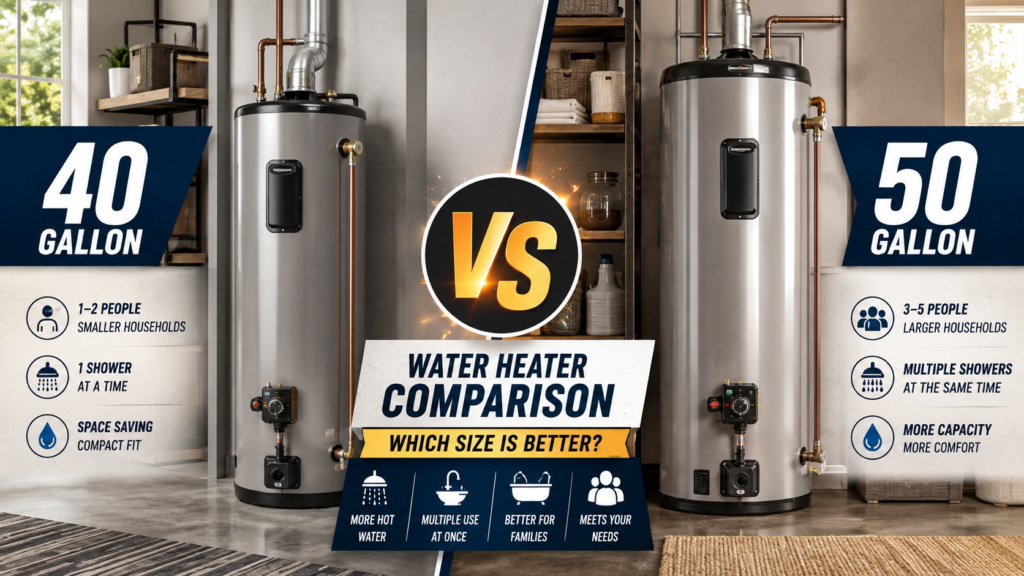
One common homeowner question is whether the jump from 40 gallons to 50 gallons is really worthwhile.
For a smaller household with modest hot-water use, 40 gallons may be enough.
As the household grows, those additional 10 gallons can provide useful breathing room.
| Household Situation | 40 Gallon | 50 Gallon |
| 1–2 people | Often suitable | Usually plenty of capacity |
| 3 people | Often workable | More comfortable margin |
| 4 people | Usage-dependent | Common size to consider |
| 5 people | May feel limited | Often worth considering |
| Frequent back-to-back showers | Can be challenging | Better starting point |
| Heavy simultaneous use | May struggle | Still requires proper demand assessment |
These are general guidelines rather than guarantees.
A family’s habits can matter more than the number of people alone.
How to Make a 50 Gallon Water Heater Work Better for a Busy Family
Sometimes the best answer is not automatically purchasing the largest tank available.
Small changes in how your family uses hot water can make a meaningful difference.
Stagger showers when possible
Even 15 or 20 minutes between high-demand activities can give an electric heater additional time to recover.
You do not necessarily need a rigid shower schedule. Simply avoiding four consecutive showers while other hot-water appliances are running can help.
Avoid stacking high-demand activities
If someone is showering, consider delaying a hot-water laundry cycle until afterward.
The same idea applies to dishwashing and bathtub filling.
Use efficient showerheads
Lower-flow showerheads can reduce the amount of hot water used without forcing family members to dramatically shorten their showers.
That means the stored hot water lasts longer.
Fix dripping hot-water faucets
A dripping faucet may look harmless, but small losses continue throughout the day.
Repairing leaks helps conserve both water and the energy used to heat it.
Use reasonable water-temperature settings
Very high thermostat settings increase scalding risk and energy use.
The U.S. Department of Energy commonly discusses 120°F as a useful household setting to consider, although individual homes and safety requirements vary. Follow the manufacturer’s instructions and ask a qualified professional when necessary.
Keep up with maintenance
A tank water heater is easy to forget because most of the time it sits quietly in a garage, basement, closet, or utility area.
Regular professional inspection and manufacturer-recommended maintenance can help identify issues before they become major household disruptions.
Where the Rheem PROE50 M2 RH95 Fits In
For homeowners already considering a traditional 50-gallon electric tank, the Rheem PROE50 M2 RH95 Professional Classic Medium Residential Electric Water Heater is one example designed around straightforward household hot-water storage.
According to the provided product specifications, it has a 50-gallon capacity and measures approximately 23 inches wide by 48 inches high.
It is a floor-mounted, corded electric model finished in gray.
Several features are particularly relevant to family homeowners.
Automatic thermostat
Families usually do not want to think about their water heater every morning.
An automatic thermostat is designed to control water temperature rather than requiring constant manual adjustment.
The everyday benefit is simple: more predictable hot-water operation for showers, cleaning and other household routines.
Resistored stainless-steel heating elements
The model uses resistored stainless-steel heating elements.
For the homeowner, the important takeaway is that the heating system is built for regular residential use rather than being another appliance requiring day-to-day attention.
Anode rod
Tank corrosion is one of the long-term concerns associated with storage water heaters.
An anode rod is included as part of the tank-protection system. It is not something the average family thinks about every morning, but it plays an important role in protecting the tank.
Enhanced-flow brass drain valve
A brass drain valve may sound like a minor specification until maintenance time arrives.
The enhanced-flow drain valve is intended to support draining and servicing the tank more conveniently.
Isolated tank design
The product specifications also list an isolated tank design among its features.
Again, this is not the kind of specification most children will ever notice, but these construction details matter when homeowners are comparing one replacement unit with another.
Rheem 50 Gallon Water Heater Specifications at a Glance
Here are the main details supplied for the model:
| Specification | Rheem PROE50 M2 RH95 |
| Brand | Rheem |
| Model | PROE50 M2 RH95 |
| Type | Residential electric tank water heater |
| Capacity | 50 gallons |
| Dimensions | Approx. 23″ W × 48″ H |
| Installation | Floor mount |
| Power source | Electric |
| Thermostat | Automatic |
| Heating elements | Resistored stainless steel |
| Tank protection | Anode rod |
| Drain valve | Enhanced-flow brass |
| Color | Gray |
| Style | Professional Classic Medium |
Specifications are useful for narrowing down options, but always verify current manufacturer documentation before ordering because product details can change.
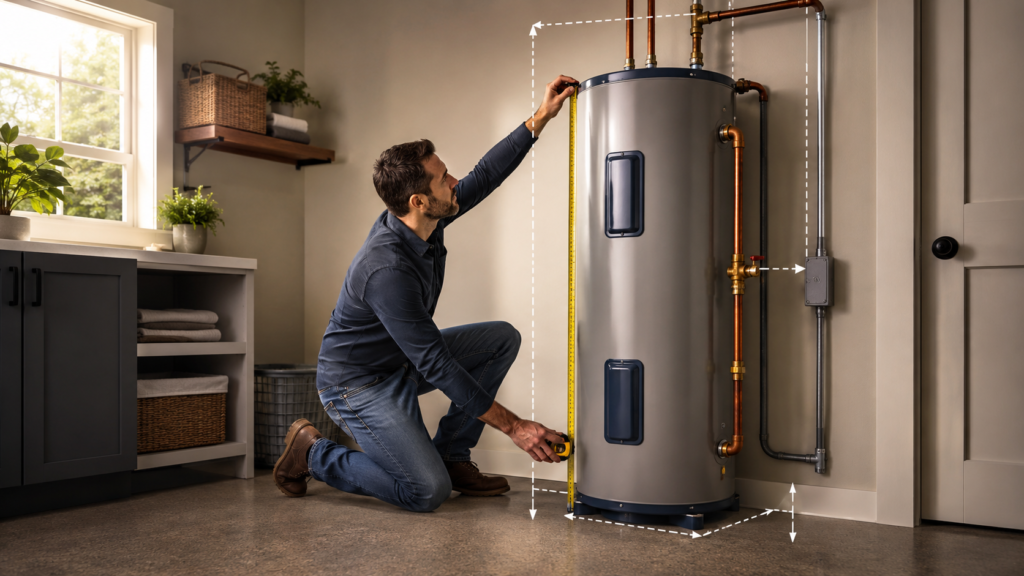
Measure Your Space Before Buying
One of the easiest mistakes in water-heater replacement is assuming that another 50-gallon model will automatically fit because the old one was also 50 gallons.
It may not.
Tank dimensions vary by model.
For the Rheem model discussed here, the supplied dimensions are about 23 inches wide and 48 inches high.
Before ordering, check:
- Available floor space
- Overall ceiling clearance
- Doorway width
- Utility-room access
- Electrical connections
- Pipe locations
- Required service clearance
- Drainage arrangements
- Local building-code requirements
Do not measure only the empty spot where the heater sits. Think about how the old tank will be removed and how the replacement will physically enter the space.
A professional installer can identify clearance or code issues that may not be obvious during online product research.
Do Not Choose a Water Heater Based on Gallons Alone
This is probably the most important takeaway for a family homeowner.
You can buy a large tank and still be unhappy if it does not match your actual household demand or installation conditions.
When comparing models, look beyond capacity.
Consider these factors together:
- Tank capacity
- First-hour performance
- Recovery capability
- Energy consumption
- Available electrical service
- Physical dimensions
- Household size
- Shower habits
- Appliance use
- Number of bathrooms
- Warranty
- Installation costs
- Local service and parts availability
The “best” water heater is not necessarily the model with the largest tank or highest price.
It is the one properly matched to your home.
How a 50 Gallon Water Heater Can Reduce Family Morning Stress
There is a surprisingly emotional side to water-heater sizing.
Nobody wakes up excited because the water heater performed correctly.
You notice it when it fails.
Imagine a family of four getting ready on Monday morning.
One parent showers at 6:30. The other goes at 6:45. The children begin getting ready soon afterward. Someone starts the dishwasher after breakfast.
When the hot-water system is correctly sized and functioning properly, nobody even thinks about it.
That is exactly the point.
Good household equipment should make daily life less complicated.
For many homeowners, moving from an undersized tank to an appropriately sized 50-gallon system provides a greater buffer between competing activities.
It does not create unlimited hot water, but it may make ordinary family routines much easier to manage.
When a 50 Gallon Water Heater Might Not Be Enough
A 50-gallon model should not automatically be presented as the right answer for every family of five.
Consider higher-demand alternatives if your household regularly has:
- Five or more people showering close together
- Large tubs filled frequently
- Multiple high-flow showers
- Several bathrooms used simultaneously
- Heavy laundry requirements
- Frequent overnight visitors
- Exceptionally high peak-hour demand
You may need to compare larger storage tanks, higher-recovery systems, heat-pump water heaters, tankless configurations, or other solutions.
Each approach has advantages and trade-offs relating to installation cost, energy use, electrical requirements and available space.
This is an area where professional sizing is worth the effort.
When Should You Replace an Existing Family Water Heater?
Do not wait for a flooded utility room before paying attention to an aging tank.
Common warning signs include:
- Water leaking around the tank
- Rust or corrosion
- Inconsistent water temperature
- Hot water disappearing much faster than before
- Unusual noises
- Discolored hot water
- Repeated repairs
- Visible deterioration around fittings
- A unit approaching the later part of its expected service life
Not every symptom requires immediate replacement, but unexplained changes should be inspected.
A qualified plumber can determine whether the problem is repairable or whether replacement makes more financial sense.
Questions to Ask Before Buying
Before ordering any 50 gallon electric water heater, sit down for five minutes and answer these questions:
- How many people use hot water in our home every day?
- How many showers happen during our busiest hour?
- Do we run laundry or the dishwasher at the same time?
- Do we regularly run out of hot water now?
- Is our current heater malfunctioning or simply too small?
- Will a 23-inch-wide tank fit our available space?
- Is our electrical setup compatible with the replacement?
- What warranty coverage comes with the exact model?
- Who will install the unit?
- What will the complete installed cost be?
Answering these questions makes comparison shopping much easier.
You stop looking for the “best water heater on the internet” and start looking for the best fit for your own family.
Frequently Asked Questions
Is a 50 gallon water heater enough for a family of four?
In many homes, yes. A 50-gallon tank is commonly considered for a family of four, particularly when showers and other hot-water activities are not all happening simultaneously.
Heavy users should also compare recovery performance and peak-hour demand before making a final decision.
Is a 50 gallon water heater enough for five people?
It can be, depending on household habits.
A five-person family taking moderate showers at different times may have very different requirements from five people taking long back-to-back showers while laundry and dishwashing are running.
For higher-demand households, professional sizing is recommended.
How many showers can you take with a 50 gallon water heater?
There is no single guaranteed number.
Shower length, showerhead flow rate, incoming cold-water temperature, thermostat setting and recovery performance all affect how many consecutive showers the system can comfortably provide.
Is 40 or 50 gallons better for a family of four?
For many four-person households, 50 gallons provides more reserve capacity than 40 gallons.
However, a properly sized 40-gallon system can still work for homes with lower hot-water demand. Compare actual peak usage rather than making the decision on household size alone.
Can I run the washing machine while someone is showering?
You can, but if the washing machine is drawing hot water, it increases demand on the water heater.
Families already struggling with insufficient hot water may find it helpful to delay laundry until after peak shower periods.
What are the dimensions of the Rheem PROE50 M2 RH95?
Based on the supplied product information, the unit measures approximately 23 inches wide by 48 inches high.
Always confirm the latest manufacturer specifications and required installation clearances before purchasing.
Does the Rheem PROE50 M2 RH95 have an automatic thermostat?
Yes. The supplied specifications list an automatic thermostat among its features, helping regulate the tank’s water temperature during normal operation.
What does the anode rod do?
An anode rod is used to help protect the inside of a storage water-heater tank from corrosion.
It is an important part of tank protection and should be inspected or serviced according to manufacturer recommendations.
Does a 50 gallon water heater provide unlimited hot water?
No. A tank stores a limited volume of heated water and reheats incoming cold water as the stored supply is used. Heavy simultaneous demand can therefore temporarily exceed its ability to maintain the desired temperature.
Should I install an electric water heater myself?
Water-heater installation involves electrical connections, plumbing, pressure and temperature safety requirements, drainage considerations, and local building codes.
Unless you have the required qualifications and your local rules permit the work, professional installation is generally the safer approach.
Making the Right Choice for Your Family
A 50 gallon water heater can be a practical middle ground for many households of around three to five people, providing more breathing room for showers, laundry, dishes, and busy family mornings. But the number printed on the tank should never be your only sizing tool.
Look at when your family uses hot water, how much demand happens at the same time, the physical installation space, recovery performance, energy requirements, and the condition of your existing system.
The Rheem PROE50 M2 RH95 offers a traditional 50-gallon electric setup with an automatic thermostat, stainless-steel heating elements, an anode rod, and an enhanced-flow brass drain valve. For the right household and installation, those features may make it worth including on your comparison list.
The goal is simple: choose a system that quietly keeps family life moving without making hot water something everyone has to think about.
Ready to Compare Your Options?
Before purchasing, confirm the current specifications, warranty, electrical requirements, and installation compatibility with the retailer or manufacturer.
Check the latest price, availability, and buyer details here
Want to see whether the Rheem PROE50 M2 RH95 fits your home’s needs and budget?