
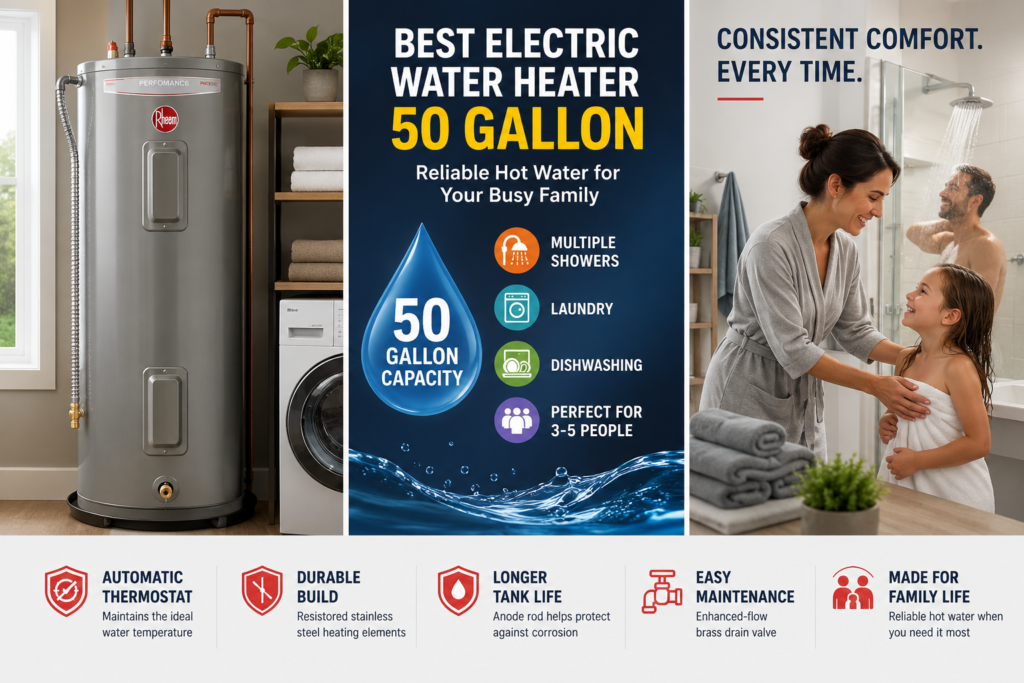
Running out of hot water halfway through for a Busy Family?
Rheem PROE50 M2 RH95 50-Gallon
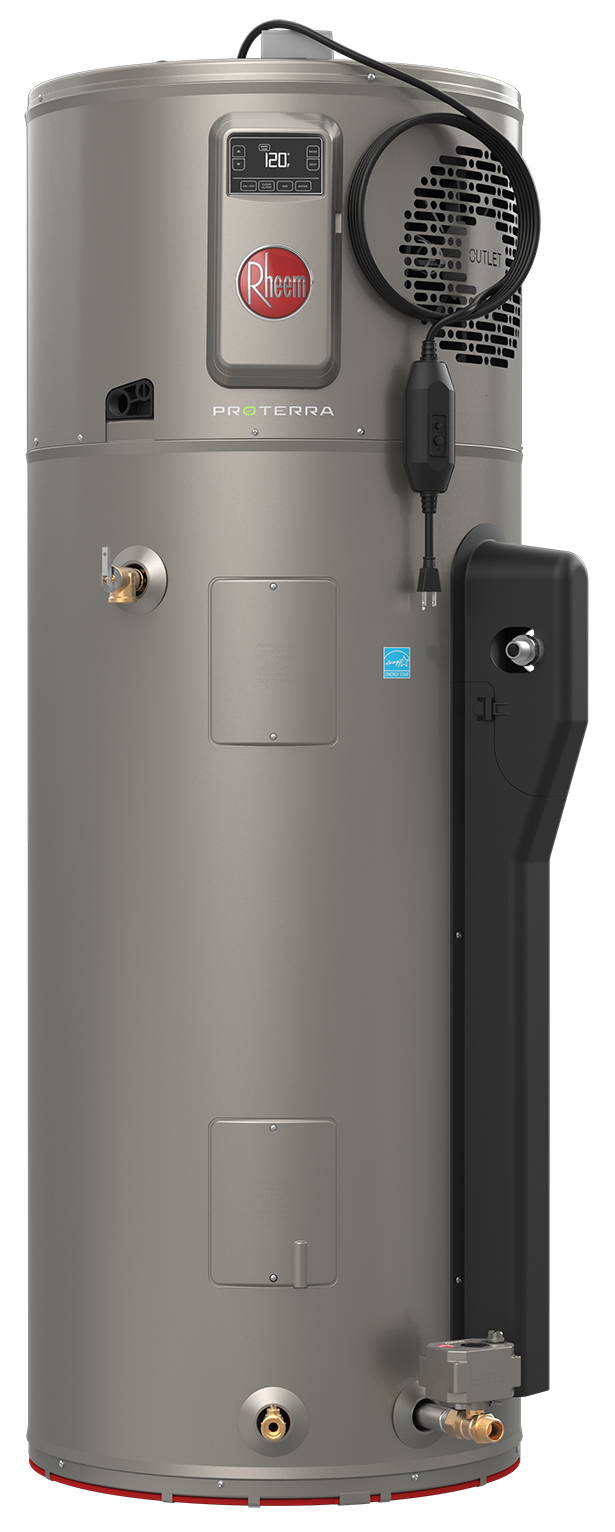
Best water heater 50 gallon
- 50-gallon capacity
- Medium-height design
- Automatic thermostat control
- Premium anode rod protection
- Enhanced-flow brass drain valve
- Temperature & pressure relief valve included
- Visible LED indicator (InfoCue)
- 18.75 Amp electrical requirement
- First Hour Rating: 62 gallons
- Recovery rate: 21 GPH at 90°F rise
Running out of hot water halfway the morning routine is more than a minor inconvenience. When several people need showers, the washing machine is running, dishes are waiting, and everyone is trying to leave the house on time, an undersized or unreliable water heater can quickly become a daily frustration.
That is why families searching for the best electric water heater 50 gallon models usually care about more than tank size. They want to know whether 50 gallons will actually support their household, how consistently the heater can maintain temperature, what features matter for durability, and whether electric or gas makes more sense for their home.
For households of roughly three to five people, a 50-gallon electric tank can offer a practical balance between hot-water capacity and installation size. The Rheem PROE50 M2 RH95 is one example worth considering because it combines a 50-gallon tank with an automatic thermostat, resistored stainless-steel heating elements, an anode rod, and an enhanced-flow brass drain valve.
This guide looks at what family homeowners should consider before choosing one—and where the Rheem model fits. The audience profile supplied for this article specifically identifies families of approximately three to five people, busy morning routines, multiple showers, laundry, dishwashing, reliability, inure as major buying priorities.
What Makes the Best Electric Water Heater 50 Gallon for a Family?
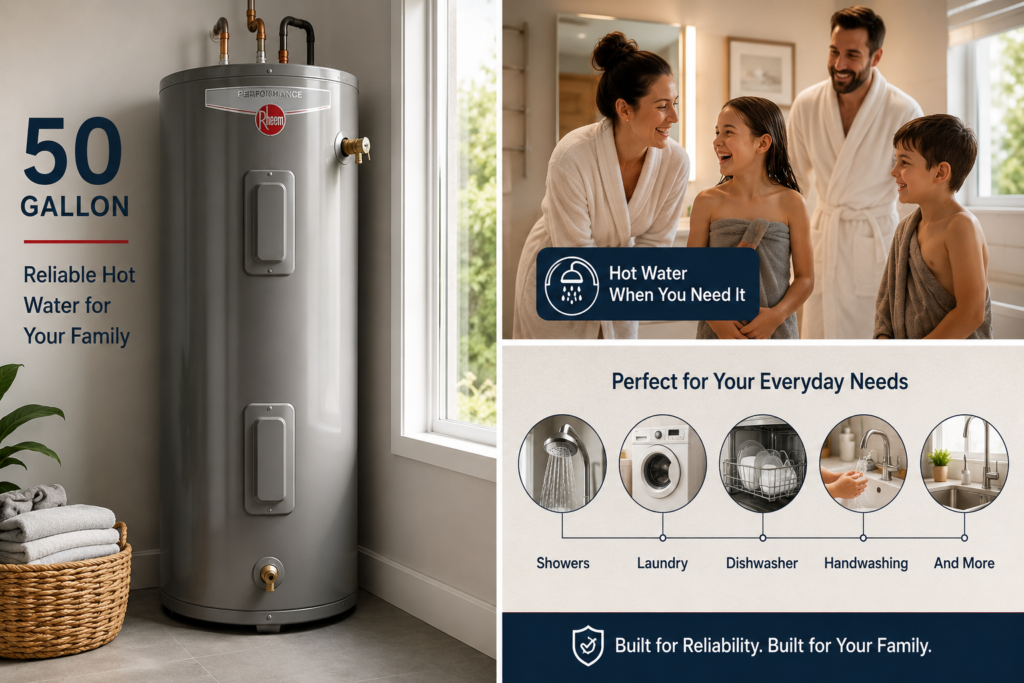
Choosing a water heater based only on the number printed on the tank can lead to disappointment.
Two 50-gallon water heaters can provide very different real-world experiences depending on heating-element performance, recovery capability, household habits, incoming water temperature, thermostat settings, and how much hot water your family uses at the same time.
For most homeowners, the right 50-gallon electric water heater should provide a sensible combination of the following.
Enough Capacity for Everyday Family Use
A 50-gallon tank is often considered by households that have outgrown smaller systems.
A family may use hot water for:
- Morning and evening showers
- Children’s baths
- Laundry
- Dishwashing
- Handwashing
- Kitchen cleanup
- General household cleaning
- Guests staying overnight
The challenge is that these activities do not always happen one at a time.
A dishwasher may be running while someone showers. Another person may need a shower immediately afterward. Meanwhile, the washing machine may also require hot or warm water.
For that reason, the real question is not simply, “Does the tank hold 50 gallons?”
It is:
“Can this water heater keep up with the way my family actually lives?”
Consistent Temperature
Nobody wants the first shower to feel perfect while the third family member gets noticeably cooler water.
A dependable thermostat matters because it controls when the heating system responds as water temperatures change.
The Rheem PROE50 M2 RH95 includes an automatic thermostat, helping the system maintain its selected water temperature without requiring homeowners to make constant manual adjustments.
That is particularly useful in busy households where comfort and predictability matter more than complicated controls.
Durable Components
Water heaters usually stay in the background until something goes wrong.
Families therefore tend to value components designed to support dependable long-term operation.
The Rheem model described here includes:
- Resistored stainless-steel heating elements
- An anode rod
- Enhanced-flow brass drain valve
- Isolated tank design
- Automatic thermostat
These features address different parts of ownership, from heating the water to tank protection and routine draining.
They do not mean a water heater will never require maintenance, but they are the kinds of practical features worth considering when comparing models.
Is a 50-Gallon Electric Water Heater Enough for a Family of 4?
For many households, yes—a properly selected 50-gallon electric water heater can be a practical choice for a family of four.
However, household size alone does not tell the entire story.
Consider two different four-person families.
Family A has two adults and two younger children. Showers are relatively short, laundry is spread throughout the week, and the dishwasher usually runs at night.
Family B has two adults and two teenagers. Everyone showers between 6:30 and 8:00 in the morning, showers tend to be longer, laundry runs frequently, and someone may use the dishwasher at the same time.
Both households contain four people, but Family B places much greater demand on the water heater.
That is why you should think about peak hot-water demand, not just total daily consumption.
Signs 50 Gallons May Be a Good Fit
A 50-gallon tank is especially worth considering if:
- Your household has about 3–5 people.
- Several family members shower each day.
- You have multiple bathrooms.
- Your current 40-gallon heater frequently runs short.
- Laundry and showers sometimes overlap.
- You regularly host relatives or overnight guests.
- You want additional capacity without moving to a significantly larger tank.
The supplied family-homeowner profile specifically emphasizes the concern families have about back-to-back showers, growing children, multi overlapping household activities.
Why Families Run Out of Hot Water
People sometimes assume that running out of hot water automatically means the water heater is broken.
That is not always the case.
Several factors can cause a household to exhaust its available hot water.
Back-to-Back Showers
Showers are usually one of the largest sources of concentrated household hot-water demand.
Imagine four people getting ready for school and work.
The first person showers for 10 minutes. The second starts immediately afterward. A third person gets in a few minutes later.
Even if the heater is functioning normally, the stored supply is being replaced with colder incoming water while the heating elements work to bring it back to temperature.
Eventually, demand can temporarily exceed recovery.
Laundry and Dishwashing at the Wrong Time
A washing machine and dishwasher may not seem related to shower comfort, but they draw from the same household hot-water system when configured to use heated water.
If your family already struggles with limited hot-water capacity, scheduling these activities during peak shower periods can make the problem worse.
A simple routine change may help.
Run the dishwasher after everyone has showered, or schedule laundry outside the busiest morning period.
An Undersized Existing Tank
A smaller water heater may have been perfectly adequate when two adults first moved into the house.
Years later, that same home may include children, teenagers, guests, another bathroom, or simply heavier daily use.
The water heater did not shrink.
The family outgrew it.
That is one reason moving from a smaller tank to a 50-gallon model can be a meaningful upgrade for growing households.
Rheem PROE50 M2 RH95: Key Features Explained
The Rheem PROE50 M2 RH95 is a 50-gallon Professional Classic Medium residential electric water heater.
Rather than treating every specification as marketing language, it helps to translate the features into practical household benefits.
50-Gallon Capacity
The main advantage is straightforward: more stored hot water than a smaller traditional tank.
For households of roughly three to five people, that capacity can provide a useful buffer during busy periods.
It may be particularly valuable when multiple showers occur close together.
Automatic Thermostat
The automatic thermostat helps regulate water temperature.
For homeowners, the practical benefit is convenience. You should not have to continually monitor the heater just to maintain normal household hot-water temperatures.
Temperature settings should still be handled carefully, particularly in homes with children, because excessively hot water can create a scalding risk.
Resistored Stainless-Steel Heating Elements
Electric tank water heaters rely on heating elements to heat stored water.
The Rheem unit uses resistored stainless-steel heating elements, according to the supplied product specifications.
For a family homeowner, heating-element construction matters because dependable heating is central to everyday performance.
Anode Rod
The anode rod is one of those components many homeowners never think about until they begin researching water-heater durability.
Its job is related to protecting the tank against corrosion.
It is also a maintenance component worth discussing with a qualified plumber because monitoring and replacing an anode rod when appropriate can form part of responsible tank-water-heater ownership.
Enhanced-Flow Brass Drain Valve
Tank water heaters may need periodic draining or flushing as part of maintenance.
The supplied Rheem specifications list an enhanced-flow brass drain valve.
A quality drain connection can make routine service more practical than dealing with a poorly designed valve.
Floor-Mounted Design
The specifications identify this model as floor mounted.
That is typical for conventional tank-style residential water heaters, but homeowners replacing an existing system should still measure the installation area before purchasing.
According to the product information provided, the unit is approximately 23 inches wide and 48 inches high.
Always compare the actual manufacturer installation dimensions and required service clearances with your home’s available space before ordering.
Best 50-Gallon Electric Water Heater: What Should You Compare?
If you are comparing several models for the title of best 50-gallon electric water heater, avoid judging them by price alone.
Use a checklist.
1. Household Capacity
Start with the number of people in your home, but then look at usage patterns.
Ask yourself:
- How many showers happen within one hour?
- Do people take long showers?
- Do you have teenagers?
- Does someone regularly fill a bathtub?
- Do you run laundry during morning routines?
- How many bathrooms are being used?
- Do guests frequently stay over?
These questions tell you more than household size alone.
2. Recovery Performance
Tank capacity determines how much heated water can be stored, while recovery performance affects how quickly the system can restore hot water after significant use.
This becomes important after two or three back-to-back showers.
When comparing products, check the manufacturer’s current recovery and first-hour performance ratings rather than assuming all 50-gallon heaters perform identically.
3. Electrical Requirements
Do not assume every electric water heater can simply replace every other one.
The Rheem product information provided lists 18.75 amps, but installation compatibility should be confirmed using the model’s current installation documentation and by a qualified professional.
Check:
- Required voltage
- Circuit requirements
- Breaker requirements
- Wiring
- Existing electrical service
- Local code requirements
A water heater is not an appliance where electrical compatibility should be guessed.
4. Tank Dimensions
Capacity does not automatically tell you physical size.
If your current heater is installed in a closet, compact utility room, basement corner, or garage enclosure, even a few inches can matter.
Measure:
- Available width
- Available height
- Clearance around the unit
- Doorway access
- Plumbing connection position
- Electrical access
- Drain location
Then compare those measurements against the manufacturer’s official installation specifications.
5. Maintenance Features
Water heaters require some care.
Useful features may include accessible drain valves, serviceable components, tank-protection systems, and clear operating information.
The brass drain valve and anode rod on the Rheem model are therefore more meaningful than they might initially appear.
40-Gallon vs. 50-Gallon Electric Water Heater
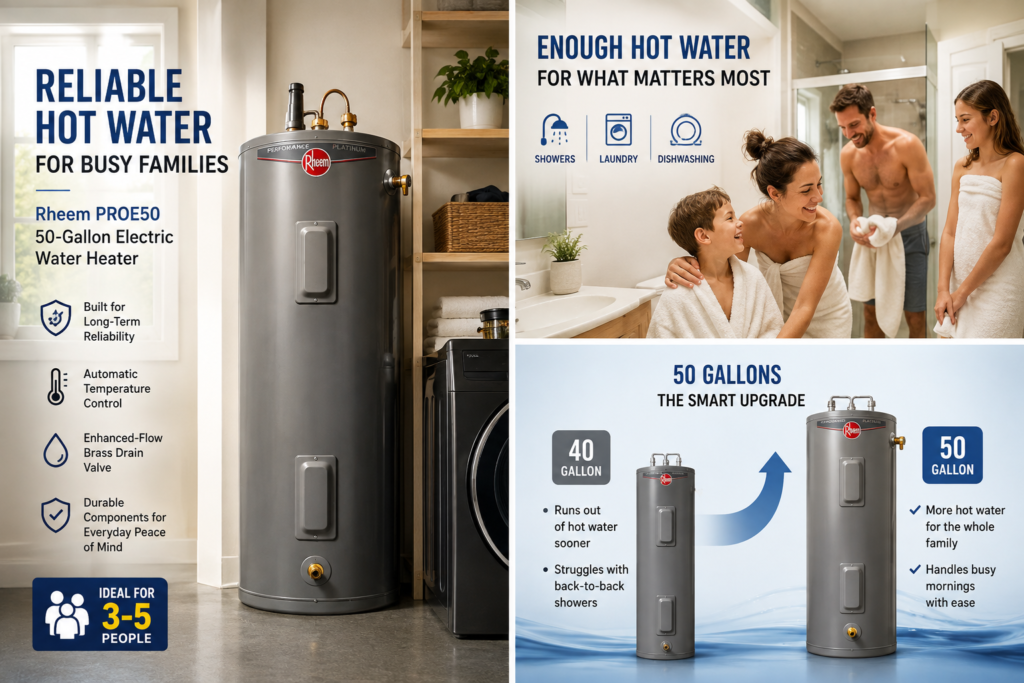
This is one of the most common sizing decisions for family homeowners.
A 40-gallon tank may work perfectly well for a lower-demand household. However, families who regularly experience cold showers during periods of concentrated use may appreciate the additional stored capacity of a 50-gallon model.
Consider the following simple comparison.
| Household Situation | 40-Gallon Tank | 50-Gallon Tank |
| 1–2 people with moderate use | Often sufficient | May be more than needed |
| 3 people | Can work depending on habits | Offers additional flexibility |
| Family of 4 | May work with controlled usage | Often more comfortable for heavier use |
| Family of 5 | Could feel limited during peak demand | Worth stronger consideration |
| Multiple back-to-back showers | Greater chance of shortage | More stored capacity available |
| Growing family | Less room for increased demand | Better buffer for changing routines |
These are practical guidelines rather than guarantees.
Actual performance depends on fixtures, shower duration, incoming water temperature, thermostat setting, recovery rate, and simultaneous hot-water use.
Electric vs. Gas: Which Is Better for Your Home?
People searching for the best electric 50 gallon water heater often encounter recommendations for the best water heater 50 gallon gas models as well.
Neither fuel type is automatically better for every home.
Your existing utility setup plays a major role.
Electric Water Heaters
Electric models can make sense when:
- Your existing heater is electric.
- The electrical infrastructure is already suitable.
- Natural gas is unavailable.
- You want to avoid adding a gas connection.
- Replacing the current system with a similar configuration makes practical sense.
Gas Water Heaters
A gas unit may deserve consideration if:
- Your home already has the appropriate gas service.
- Your existing water heater is gas.
- Installation requirements can be safely met.
- Venting is properly available.
- Local energy pricing makes gas attractive.
Do not switch fuel types based solely on an online “best water heater” ranking.
Changing from electric to gas—or gas to electric—can involve infrastructure, venting, electrical, plumbing, permitting, and installation considerations.
For many homeowners, staying with the home’s existing compatible fuel source is the more straightforward replacement path unless there is a specific reason to convert.
What About the Best Short 50-Gallon Electric Water Heater?
The phrase best short 50-gallon electric water heater usually comes from homeowners dealing with restricted installation height.
Short, lowboy, medium, and tall water-heater configurations allow manufacturers to provide similar capacities in different shapes.
A short model may make sense when:
- Height is severely limited.
- The heater sits under shelving.
- The installation is beneath stairs.
- The mechanical area has low overhead clearance.
- A standard-height tank physically will not fit.
However, the Rheem PROE50 M2 RH95 discussed here is described as a medium model, not a short model.
That distinction matters.
If height is your biggest constraint, do not choose this unit simply because it holds 50 gallons. Compare its dimensions against dedicated short or lowboy 50-gallon electric water heaters.
If you have adequate vertical space, a medium configuration may work well without needing to prioritize a short design.
How Families Can Make 50 Gallons Go Further
Even the best water heater has limits.
Changing a few household habits can reduce unnecessary hot-water waste and make a 50-gallon system feel more capable during busy periods.
Stagger Heavy Hot-Water Activities
Avoid running every hot-water appliance at once.
For example:
- Let everyone finish morning showers.
- Run the washing machine afterward.
- Schedule the dishwasher later in the morning or at night.
You are not using less hot water simply for the sake of inconvenience. You are reducing peak simultaneous demand.
Consider Shower Length
A few extra minutes per shower becomes significant across four or five family members.
Shortening an unnecessarily long shower even slightly can leave considerably more stored hot water for the next person.
Check Showerheads and Fixtures
High-flow fixtures consume stored hot water more quickly.
Efficient showerheads may help extend the available supply without requiring the family to completely change its routine.
Fix Hot-Water Leaks
A dripping hot-water faucet wastes both water and the energy used to heat it.
Individually, a small leak may appear insignificant.
Over days and months, it can become unnecessary household waste.
Maintain the Water Heater
Routine maintenance recommendations vary by system and local water conditions.
Sediment accumulation, component wear, and corrosion-related issues can affect water-heater ownership over time.
Follow the manufacturer’s instructions and use a qualified technician when inspection, electrical work, plumbing work, or component replacement is required.
Signs Your Family May Need a New Water Heater
Running out of hot water does not automatically mean replacement is required.
However, certain symptoms deserve attention.
Watch for:
- Hot water running out much faster than before
- Inconsistent temperature
- Water not becoming sufficiently hot
- Visible tank leakage
- Rust or corrosion
- Unusual sounds
- Repeated repair needs
- A heater that no longer meets growing household demand
Some issues may be repairable.
Others may indicate that replacement is becoming more practical.
A qualified plumber or water-heater technician can help determine whether the problem is sizing, maintenance, a failed component, or the condition of the tank itself.
Is the Rheem PROE50 M2 RH95 a Good Fit for Families?
Based on the specifications supplied, the Rheem PROE50 M2 RH95 appears most relevant to homeowners who want a conventional 50-gallon residential electric tank water heater and whose household demands align with that capacity.
Its strongest family-focused attributes include:
- 50-gallon storage capacity
- Automatic thermostat
- Resistored stainless-steel heating elements
- Anode rod for tank protection
- Enhanced-flow brass drain valve
- Conventional floor-mounted format
- Rheem branding
- Medium residential configuration
The benefit is not that any one feature is revolutionary.
The appeal is the combination of features aimed at doing an essential household job reliably: keeping heated water available for everyday routines.
That makes it especially relevant to parents who care less about complicated technology and more about whether showers, dishes, laundry, and baths can happen without constant hot-water anxiety.
When This Rheem 50-Gallon Heater May Not Be the Best Choice
No water heater is right for every home.
You may need to consider another configuration if:
- Your household regularly has six or more high-demand users.
- Your home’s peak hot-water demand greatly exceeds a typical 50-gallon system.
- You specifically need a short or lowboy tank.
- Your installation area cannot accommodate the unit.
- Your home is currently designed around gas equipment.
- You want a tankless system.
- Your electrical service cannot support the required installation.
- You are prioritizing a different efficiency technology, such as a heat-pump water heater.
Recognizing when a product is not appropriate is part of making a good purchase.
The goal is not to force a specific water heater into every household. It is to match your family, home, utilities, and hot-water usage to the right equipment.
Questions to Ask Before Buying a 50-Gallon Electric Water Heater
Before clicking “buy,” answer these questions.
How Many People Live in the House?
A household of three to five people is a reasonable starting point for considering 50 gallons, but usage habits remain important.
When Does Our Highest Demand Occur?
Think about your busiest hour rather than the entire day.
Morning may involve:
- Four showers
- Handwashing
- Kitchen cleanup
- Laundry
- Dishwasher use
That period matters far more than six quiet hours later in the day.
Does the Heater Physically Fit?
Measure first.
Do not rely on the capacity label.
Is My Electrical Setup Compatible?
Have the required electrical specifications verified, especially if you are replacing a different model or capacity.
Is 50 Gallons Actually Enough?
If your current 50-gallon heater already struggles despite operating properly, replacing it with another similar-capacity tank may not solve the underlying sizing problem.
Consider peak demand and recovery performance.
Who Will Install It?
Water-heater installation involves electricity, pressurized plumbing, temperature control, drainage, local codes, and safety requirements.
Professional installation is generally the sensible choice for homeowners who are not qualified to perform this type of work.
Frequently Asked Questions
What is the best electric water heater 50 gallon for a family?
There is no single model that is best for every family. A good choice should match household size, peak hot-water demand, installation space, electrical requirements, recovery needs, budget, warranty preferences, and maintenance expectations.
The Rheem PROE50 M2 RH95 is worth considering for households seeking a conventional 50-gallon electric tank with an automatic thermostat, resistored stainless-steel heating elements, an anode rod, and a brass drain valve.
Is a 50-gallon water heater enough for 5 people?
It can be suitable for some five-person households, particularly when hot-water demand is reasonably managed.
However, five people taking long back-to-back showers while laundry and dishwashing are running may create considerably greater demand.
Household behavior and peak usage should therefore be considered alongside tank capacity.
Is a 50-gallon water heater good for a family of 4?
For many families of four, 50 gallons can provide a practical balance of capacity and size.
It may be especially appealing to households that find smaller tanks restrictive during morning or evening routines.
Is Rheem a good option for a 50-gallon electric heater?
The provided Rheem model includes several practical features family homeowners typically look for, including a 50-gallon tank, automatic thermostat, stainless-steel heating elements, anode rod, and brass drain valve.
Whether it is the right option depends on your installation and household requirements.
Should I buy a 40- or 50-gallon electric water heater?
Smaller or low-demand households may be comfortable with 40 gallons.
Families with several people, multiple bathrooms, frequent showers, or overlapping hot-water activities may appreciate the additional capacity offered by 50 gallons.
Is a short 50-gallon water heater better?
Only when its dimensions better match your installation.
Short models are primarily useful where vertical space is limited. The Rheem PROE50 M2 RH95 discussed here is described as a medium model, so homeowners specifically needing a short heater should compare other configurations.
Can a 50-gallon water heater stop us from ever running out of hot water?
No tank-style water heater provides unlimited hot water.
A 50-gallon unit increases stored capacity compared with a smaller tank, but exceptionally heavy simultaneous use can still temporarily exceed available supply and recovery.
Choosing the Best Electric Water Heater 50 Gallon for Your Home
Finding the best electric water heater 50 gallon option is ultimately about matching the heater to your family’s real routine—not simply choosing the biggest specification or most recognizable name. For households of roughly three to five people, 50 gallons can provide a useful balance between everyday capacity, installation size, and family comfort.
The Rheem PROE50 M2 RH95 brings together practical features including an automatic thermostat, resistored stainless-steel heating elements, an anode rod, and an enhanced-flow brass drain valve. Those features make it worth considering for busy homes where dependable showers, laundry, dishes, and daily routines matter.
Before purchasing, confirm your peak hot-water demand, available installation space, electrical compatibility, official manufacturer specifications, and installation requirements. The right choice is the one that keeps your family’s routine comfortable without paying for capacity or features your home does not actually need.